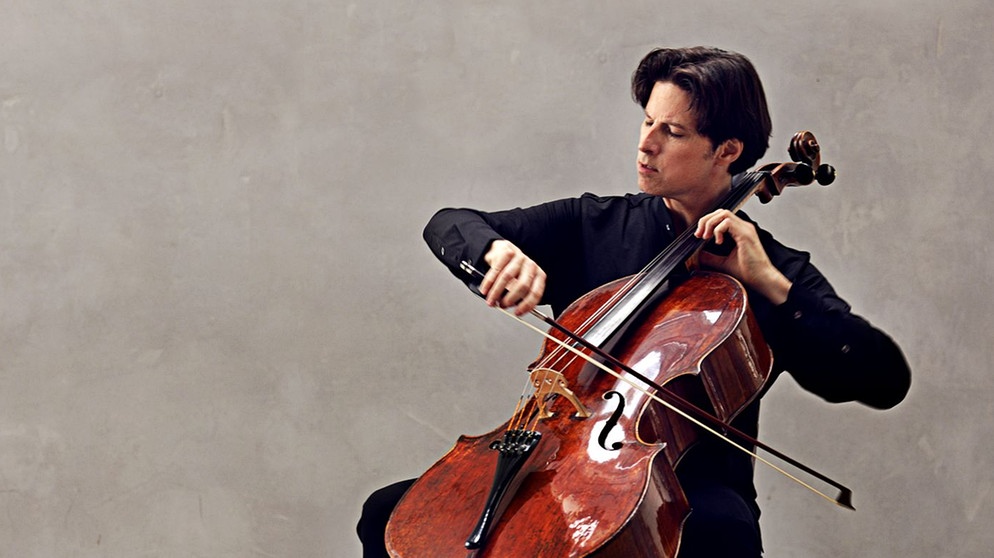
By Antonia Morin for BR Klassik
Broadcast: "Leporello" on 26. June 2026 from 16:05 on BR-Klassik
*This interview has been translated
BR-Klassik: Let’s look a little ahead. Next year you have something special in mind: You are jury chairman of the new cello competition "Danish International Cello Competition". There are countless music competitions around the world. Let’s be honest: Why does it still need a cello competition?
Daniel Müller-Schott: The initiative then goes back that there is no cello competition in Denmark. In Scandinavia, this distribution of competitions has not actually taken place. I played with the orchestra in Copenhagen and we just got into the conversation: What could you do? What can be brought about that may not be so much in focus in the conventional major competitions? Despite the fact that there are of course many competitions, it is important that you look at the situation after the competition. It doesn't help if someone wins a first prize and then gets a few concerts, but doesn't really create something that carries in the long term. That's where we try to give support and find new approaches.
BR-Klassik: Among other things, there will be some kind of career mentoring. "CelloBridge" is what you called it. What's behind it?
Daniel Müller-Schott: In my youth I received support from the Anne Sophie Mother Foundation and also from wonderful teachers and colleagues. But not everyone has this group of people who support you, who also keep you mentally on a level that you can and want to evolve. I would like to develop this long-term tutoring together with the competition.
BR-Klassik: 24 cellists are admitted to the competition, you can apply from August. And interesting about your concept is that all 24 can participate in one-on-one meetings, workshops and panel discussions – regardless of whether they fly out in the preliminary round, whether they get a prize or not.
Daniel Müller-Schott: The talks are an important part of this competition. It's about finding your own voice - and also optimizing the instruments. If everything works out, I bring my long-time friend, the violin maker Dietmar Rexhausen, with him, who builds cello himself and can also do things to sound. We want a context that is supportive and not so judging. You have to start with the good things. There is always something to improve. That stays the way it is all life. To convey that is my credo.
BR-Klassik: What is important so that you can make a long and healthy career in the classical music business?
Daniel Müller-Schott: There are so many disturbances in our time as never before, which make you lose focus. The focus is to find your own inner voice. To see in general: What do I want to express through the multitude of wonderful compositions? What part do I want to contribute to further hearing the works in the future? The focus, of course, is also on dealing with the biographies of the composers and getting to know their lives in such a way that they really become friends, friends of the past. It's this idea that you deepen that connection until you get a really personal picture. The audience feels that, too. People who come to the concert want you to create a connection, to experience music together.
BR-Klassik: But a competition is also about evaluating an artistic achievement, pointing by criteria, comparing it. Is the question "Who is the best or the best?" At all appropriate for music?
Daniel Müller-Schott: There is this famous quote from Bartók, who says that music competitions are actually not allowed to take place and competitions are actually only for horses, but not for people. There's something to it. Because it's not like in sports. Musicians don't score goals and don't run a hundred yards in nine seconds. Therefore, a clear evaluation remains difficult. Nevertheless, I think the competitions have this justification because they are also a platform to perceive young artists. Especially streaming and video recordings offer the opportunity for all candidates to be really seen and heard. It wasn't like that before. In the Tchaikovsky competition earlier or also in the ARD music competition, only the finalists were perceived and perhaps only the first prize winner. Today it is much more democratic.
BR-Klassik: So the mindset to join your new cello competition would be more like: "I want to use this platform to show who I am." And not: "I want to compete against others here and absolutely win."
Daniel Müller-Schott: Absolutely. I was just on the jury from the Queen Elizabeth Competition in Brussels. I was really touched by how the young cellists dealt with each other in the final. One week they were almost locked away to learn the contemporary piece for the finale. They had no cell phone and were thrown back on themselves, so to speak. The cellists have supported each other so wonderfully. It was really great to see how friendly and empathetic they are with each other. You can see that a lot is changing in the young generation. It's much less a mutual than a togetherness. Everyone knows we're in the same boat. And the times are not the easiest. This may also lead to a different spirit among the cellists. They were really very warm with each other. I also hope for the competition in Denmark that the same spirit can be felt there. That would be great.
Read the full interview with the DICC 2027 president: Daniel Müller-Schott, at BR Klassik's official site









%20(1000%20x%201000%20px)%20(1000%20x%20500%20px).png)


.gif)


.svg)
.svg)